Badger Beadon
Why Didn't They Ask EvansBadger Beadon, an old friend of Bobby Jones, is a serially unsuccessful businessman whose comic mishaps conceal a dependable loyalty. His ventures repeatedly founder, and he arrives in Staverley amid debts and creditors; yet when Bobby and Frankie Derwent are held captive, Badger finds a way to reach them and cuts them free. His movement from bumbling associate to useful rescuer gives his comedy a practical payoff, and the ending finally grants him success in the garage business he had so confidently imagined.
Identity and Background
Bobby introduces Badger as a friend he has been to see about a proposed garage business. Frankie Derwent needs prompting before she remembers him: as children, he fell from his pony into mud, head down, and had to be hauled out by his legs. She also recalls his stammer. The childhood mishap becomes a compact introduction to the character’s recurring mixture of physical awkwardness and good humour, while Bobby’s proud insistence that Badger still stammers signals the affection behind his teasing.
Badger’s appearance and manner reinforce that impression when he meets Frankie again. He has a nervous look, little chin, eyes that seem reluctant to look in the same direction, and a laugh that Frankie recognizes only after hearing it again. He does not immediately remember her, but responds amiably; once she reminds him of the childhood fall, he confirms the memory and ruefully admits that he was, and remains, a poor rider. The scene makes recognition affectionate rather than solemn: the friends’ histories are carried in repeated stories, laughter, and an enduring stammer.
A Record of Failed Ventures
Frankie can recite Badger’s recent professional history. His chicken farm went bankrupt; after that, he entered a stockbroker’s office and was dismissed within a month; he was then sent to Australia and returned. This string of reversals establishes a pattern before the garage venture begins. Badger is not short of plans, but his past gives Frankie ample reason to question whether the next one will work. Bobby, by contrast, is considering joining him despite having no money to invest, and Frankie concludes that the absence of capital is just as well.
Badger’s own account of the new enterprise arrives in a letter written in an illiterate scrawl. He says he has acquired five cars for fifteen pounds in total: an Austin, two Morrises, and two Rovers. None will run as they stand, but he believes they can be tinkered into working order. His plan is to paint them, open for business the following Monday week, and rely on Bobby to join him. The letter’s confidence outruns its evidence: Badger treats a car as saleable so long as it can get the purchaser home without breaking down, and assumes that a fresh coat of paint will satisfy an ordinary buyer. His cheerful certainty, including the claim that the business is bound to succeed, is funny partly because the cars are not yet operational and his earlier ventures have failed.
The letter also explains why Badger thinks he can finance the scheme. He recalls that Aunt Carrie had been generous to him after he broke a neighbour’s window in retaliation for the neighbour’s rudeness about her cats; she had sent him money each Christmas, and he now refers to what she left him as his backing. The anecdote gives his proposal a personal, haphazard history: the capital for the garage is tied not to business experience but to an old act of loyalty and an indulgent relative.
Friendship and Practical Cooperation
Bobby and Badger’s friendship is marked by familiarity rather than formality. Bobby expects Frankie to remember him, and later turns to him directly when he fears that the people pursuing him may be watching his new address. Badger answers without demanding an explanation in that moment. Bobby spends several minutes giving him instructions; by the end, Badger can repeat them from memory. Their exchange shows that beneath the jokes and Badger’s record of failure, Bobby trusts him to listen closely and carry out a task accurately.
Badger’s reliability matters because Bobby cannot safely move about openly. After instructing him, Bobby leaves in an old two-seater Flat and goes to his club to make telephone calls; parcels are delivered there, and a chauffeur in dark green livery later approaches the Bentley parked nearby. The episode places Badger within Bobby’s preparations, though the text does not specify that Badger is the chauffeur. His role is as a trusted recipient of instructions at a moment when secrecy makes dependable cooperation essential.
Rescue and Reversal
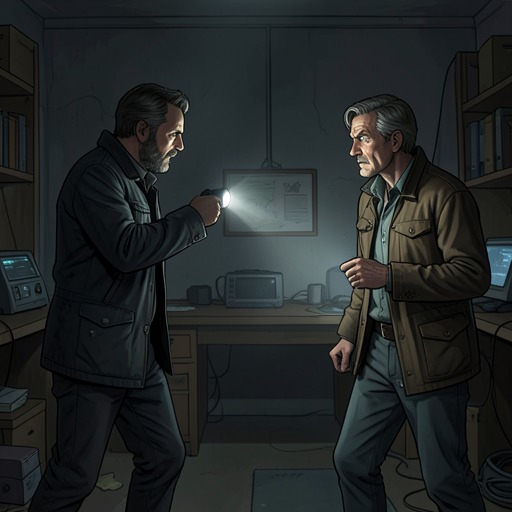
Badger’s most consequential appearance comes during the danger surrounding Bobby and Frankie. From amid broken glass, he calls to Bobby, who recognizes him with astonishment. The precise route by which he has reached the room is treated as a mystery even to Bobby, who later asks what miracle brought him through the skylight. Badger’s entrance turns an apparent captivity into an opportunity for escape: he has a pocket knife, and uses it to cut Bobby and Frankie free while sounds approach from downstairs.
The rescue is not presented as a transformation into a polished adventurer. Badger arrives as himself, still stammering, and his explanation unfolds as a familiar tale of liabilities, creditors, and bailiffs. After Bobby left without an address, saying only that he was taking the Bentley to Staverley, Badger went there, hoping Bobby might be able to lend him five pounds. His financial predicament, which might seem merely another comic disaster, has brought him into the place where his help is urgently needed. In that reversal, the pattern of Badger’s misfortune becomes the means of his usefulness.
Outcome and Narrative Role
Badger’s presence helps convert Bobby and Frankie’s escape from a private struggle into a shared effort: once they are free, they plan with him to confront their captor. His contribution is modest and concrete—he remembers instructions, arrives unexpectedly, and uses a pocket knife—but those actions matter more than any display of expertise. The contrast between his failed schemes and his timely assistance keeps the character comic without making him disposable.
By the close, the garage business is doing well, with help from Frankie’s father. The success reverses the earlier sequence of failed work and extravagant optimism: the enterprise that began with five unusable cars and a boast about paint has, at last, become a going concern. Badger’s ending does not erase his mishaps; it gives them a counterweight. He remains the same awkward, irrepressible friend, but the story’s final accounting allows one of his schemes to succeed—and makes his loyalty to Bobby as important as his business fortunes.